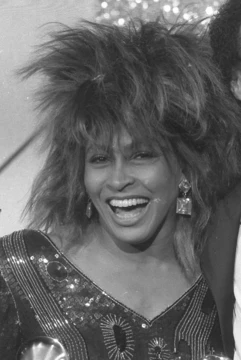
The Ikettes
The voices that made Tina's roar feel like a whole army singing back.

The Ikettes were the electrifying backing vocal ensemble that formed the sonic and visual backbone of the Ike & Tina Turner Revue during its most explosive era. Named as a playful nod to Tina's nickname for Ike, the group of women delivered the layered harmonies, ad-libs, and sheer vocal firepower that turned Tina's performances into full-throated spectacles. Without their interlocking parts and stage presence, the Revue's signature sound would have been flattened to a single voice against a rhythm section. More than a studio convenience, the Ikettes were a live performance unit that moved, danced, and projected energy in lockstep with Tina, creating the wall-of-sound-and-motion that audiences still describe as almost physical. They remain one of the most beloved supporting acts in rock-and-roll history, a testament to the idea that a great frontwoman is built on a foundation of extraordinary women around her.
- Role
- Backing vocal group / live performance ensemble
- Affiliation
- Ike & Tina Turner Revue
- Named after
- Ike Turner (Tina's nickname for him)
- Active era
- Mid-1960s through early 1970s
- Notable member
- Marcella Anderson
- Function
- Studio and live backing vocals, stage choreography, visual spectacle
Lore & Background
The Ikettes emerged organically from the Ike & Tina Turner Revue's need for a vocal engine that could match Tina's raw power without competing with her. In the mid-1960s, as the Revue's live shows grew in scope and the band's studio work demanded richer vocal textures, a rotating cast of women was assembled to handle harmonies, call-and-response, and the breathless 'oohs' and 'aahs' that underpinned tracks like 'River Deep – Mountain High' and the relentless live setlists. The name itself—'Ikettes'—was a private joke that became public branding, a small affectionate thread tying the group's identity to the couple at the center of the show. On stage, the Ikettes were as much a visual element as an auditory one. Dressed in matching, often vividly colored outfits, they moved in synchronized bursts of energy, clapping, swaying, and projecting microphones toward the audience to pull in the crowd. Their choreography was loose and joyful rather than rigid, giving the impression of a group of friends losing themselves in the music. This physicality was essential: in a show built on Tina's larger-than-life persona, the Ikettes provided the human-scale warmth and collective exuberance that made the spectacle feel communal rather than solitary. Their studio contributions were equally vital. The layered vocal tracks on the Revue's recordings carried much of the harmonic weight, and the interplay between their parts and Tina's lead line is what gives the classic material its fullness. While Tina's voice dominated, the Ikettes' work in the booth—tracking multiple takes, adjusting blends, adding spontaneous ad-libs—was a collaborative craft that shaped the final sound. Over the years, the lineup shifted as members came and went, but the role remained constant: to be the voice behind the voice, the chorus that made the solo feel like a conversation.
In Their Own Story
The house lights kill. A low hum builds from the audience, three thousand people pressing forward. Then a single voice—Marcella, maybe, or Ann—cuts through the dark with a sustained 'Mmmmm' that rolls out like a freight train. One by one the others join, stacking the note, bending it, letting it waver just enough to feel alive. A beat. Two. The rhythm section cracks in. And then Tina steps to the mic, and the Ikettes scatter behind her like a wave breaking, their voices a river she surfs on. The crowd is on its feet before the first chorus ends. You can feel the bass in your sternum, the cymbals in your teeth, and the Ikettes' laughter ringing out between phrases like sparks off a welding torch. This is not a concert. This is a congregation, and the music is the only scripture anyone needs.
Reader's Guide
The Ikettes formed in the mid-1960s as the Ike & Tina Turner Revue's live shows grew beyond what a single backing singer could sustain. The group was never a fixed, permanent roster; members rotated in and out over the years, with Marcella Anderson becoming the most publicly recognized face and voice. Ann Mitchell and others also appeared in various configurations. The lineup was flexible by design, adapting to touring schedules, studio sessions, and the physical demands of the Revue's marathon shows. Their sound was built on close, stacked harmonies with a gospel-inflected warmth, layered over the band's driving R&B and rock rhythms. In the studio, the Ikettes tracked multiple vocal passes to create a thick, almost choral texture beneath Tina's lead. Live, they traded that polish for raw, shouted energy—clapping, ad-libbing, and throwing their voices into the crowd to drag the audience into the performance. The contrast between the polished studio blend and the feral live delivery is part of what made the Revue feel so different on record versus in the room. The Ikettes were inseparable from Tina's artistic identity. They gave her a sonic landscape to play against, a call-and-response partner that made her improvisation feel like dialogue rather than monologue. Visually, their matching outfits and synchronized movement framed Tina as the focal point while keeping the stage feeling populated and alive. They were the chorus, the congregation, the engine room. And while Tina's name carried the show, fans who were there always remembered the women behind her, singing until their voices cracked, laughing between numbers, and making the impossible feel like a Tuesday night.
Did You Know?
- The name 'Ikettes' was a playful, affectionate reference to Ike Turner—Tina's private nickname for him—making the group's identity a small inside joke that became public branding.
- Marcella Anderson is the Ikettes member most widely recognized by name in retrospectives and fan discussions, often cited as the group's most prominent voice.
- The Ikettes' live choreography and matching costumes were a deliberate part of the Revue's visual spectacle, designed to create a unified, high-energy wall of performers behind Tina.
- Their studio vocal work involved multiple layered tracks and spontaneous ad-libs, meaning the 'Ikettes sound' on a record was often the product of many takes and sessions rather than a single performance.
Origins: From a No-Show to a Revue
When a scheduled recording session fell apart in early 1960 because R&B singer Art Lassiter simply never showed up, bandleader Ike Turner found himself in a bind. His solution was to grab the three women who had been Lassiter's backing trio—the Artettes, Robbie Montgomery, Frances Hodges, and Sandra Hardin—and put them in the studio with his vocalist Little Ann, who would soon become Tina Turner. The resulting single, "A Fool in Love," became a hit, and Turner capitalized on the momentum by launching the Ike & Tina Turner Revue. He then assembled a fresh backing trio of Delores Johnson, Eloise Hester, and Jo Armstead, since Montgomery was expecting a baby and couldn't tour. Once Montgomery recovered, she reunited with Jessie Smith, plucked from Benny Sharp and the Zorros of Rhythm, and gospel singer Venetta Fields from Buffalo, New York, to form what would be recognized as the first official Ikettes lineup. What began as a last-minute fix for a missed appointment became the backbone of one of rock and roll's most iconic acts.
More Than Backing Vocals: A Recording Career of Their Own
Although the Ikettes were first and foremost the vocal engine behind Tina Turner, they carved out a distinct identity as recording artists. Their 1961 single "I'm Blue (The Gong-Gong Song)," released on Atco Records, climbed to No. 3 on the Billboard R&B chart and No. 19 on the Hot 100. In 1965, "Peaches 'N' Cream" and "I'm So Thankful" both charted on Modern Records, and in 1968, "So Fine" reached No. 50 on the R&B chart under the Pompeii label. The group also issued their debut album, Soul the Hits, in 1966, and later tackled covers of the Beatles' "Come Together" and Sly & the Family Stone's "I Want to Take You Higher" for Liberty Records in the late 1960s. Their final known single, "Two Timin', Double Dealin'," appeared in 1972. Decades later, in 2017, Billboard placed "I'm Blue (The Gong-Gong Song)" at No. 63 on its list of the 100 Greatest Girl Group Songs of All Time—a testament to the fact that these women were never merely an accompaniment.
Life on the Road: Stagecraft and the Circuit
The Ikettes were as much a visual spectacle as a musical one. Their performances featured tightly synchronized dance routines, short minidresses, and a high-energy delivery designed to complement and amplify Tina Turner's commanding lead vocals. The revue spent years grinding the Chitlin' Circuit through the segregated South, with select appearances at marquee venues like the Apollo in New York, Howard in Washington, D.C., and the Uptown in Philadelphia. They also rode the Dick Clark Caravan of Stars and toured alongside the Rolling Stones in both Britain in 1966 and America in 1969. Television brought them wider visibility on shows including The Ed Sullivan Show, The Andy Williams Show, The Tonight Show Starring Johnny Carson, Playboy After Dark, and Soul Train. In October 1972, they performed at the Star-Spangled Women for McGovern–Shriver concert at Madison Square Garden. One of the more unusual chapters involved Bonnie Bramlett, who briefly joined as the first white Ikette at age seventeen, wearing a dark wig and using Man Tan to alter her appearance for just three days.
A Churning Roster and a Lasting Imprint
No single lineup defined the Ikettes for long. Members rotated in and out throughout the 1960s and 70s, with names like Pat Arnold, Shelly Clark, Paulette Parker, Claudia Lennear, Pat Powdrill, and Lejeune "Edna" Richardson all passing through. The most celebrated trio—Robbie Montgomery, Jessie Smith, and Venetta Fields—eventually departed to form the Mirettes, forcing Turner to recruit yet another set of singers. Shelly Clark's tenure was cut short by a bus accident in Wichita, Kansas. Despite the constant turnover, Ester Jones, nicknamed "Motha" Ikette, remained the group's longest-serving member and served as rehearsal leader and choreographer. The Ikettes also lent their voices beyond the Turner orbit, contributing backing vocals to Frank Zappa's Over-Nite Sensation and Apostrophe (') at the Turners' Bolic Sound studio in Inglewood, and to Gayle McCormick's 1972 album Flesh & Blood. Their legacy endures not just in chart positions but in the blueprint they set for female vocal groups in R&B and soul.
Frequently Asked Questions
Who are The Ikettes?
The Ikettes were the all-female backing vocal ensemble that anchored the Ike & Tina Turner Revue at its height. They supplied the layered harmonies, ad-libs, and on-stage energy that turned Tina's solo sets into full-throated group spectacles.
Why are they called 'The Ikettes'?
The name is a playful riff on the nickname Tina used for Ike Turner, essentially branding the group as a linguistic wink at him. It's an informal, affectionate label rather than a formal title.
What exactly did The Ikettes do during a performance?
Beyond singing interlocking vocal parts and trading call-and-response lines, they performed choreographed movement that added a visual layer to the show. Their combined presence made the Revue sound and look like a full army rather than one singer over a rhythm section.
How long were The Ikettes active with the Revue?
They were a core part of the group from the mid-1960s through the early 1970s, spanning the Revue's most commercially explosive and culturally dominant years.
Who is a notable member of The Ikettes?
Marcella Anderson is one of the most frequently cited names in the ensemble. She was part of the vocal unit that delivered the raw, interlocking firepower behind Tina's live shows.
More in Bands & Musical Groups
Elsewhere in the Tina Turner universe
Spotted an error? Know more?
This is a living reference — every entry is fact-audited, and reader corrections feed straight into our audit queue. Suggest an edit · See this site's audit record