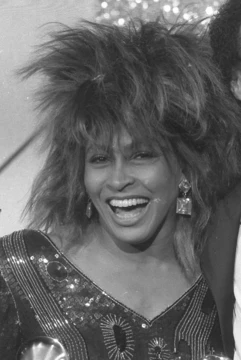
Tina Turner and Band (Private Dancer Tour)
The five-octave storm that turned arenas into cathedrals of pure, unfiltered rock and roll.

Tina Turner and Band, in the configuration that toured in support of the Private Dancer album, represents the definitive solo-era ensemble of one of rock and roll's most electrifying performers. Formed around Tina's triumphant 1984 solo comeback, this touring group combined a tight rhythm section, a punchy horn line, and a stack of backup vocalists to deliver a show that was as much a spectacle of raw physical energy as it was a musical performance. It stands in sharp contrast to the earlier Ike & Tina structure: here, Tina was the undisputed center, the bandleader, the one the lights followed.
The Private Dancer tour (1985–1986) became a cultural phenomenon, drawing arenas packed with fans who had followed Tina through the turbulent years of her marriage to Ike Turner and her subsequent reinvention. The band's role was to underpin Tina's vocals and choreography with a driving, funk-inflected rock sound, creating a wall of rhythm and brass that made her solo runs and dance breaks feel like the climax of a storm rather than an interlude.
- Leader / Frontperson
- Tina Turner
- Era
- Mid-1980s (touring 1985–1986)
- Genre blend
- Rock / R&B / Soul / Funk
- Associated album
- Private Dancer (1984)
- Context
- Tina's solo career, post-separation from Ike Turner
- Performance style
- High-energy live spectacle with choreography and horn stabs
Lore & Background
By the time Private Dancer hit shelves, Tina had already endured what most artists never face: a marriage that was also a musical partnership in which she was the voice, the instrument, and the public face while the credit and control sat elsewhere. The dissolution of that dynamic in the mid-1970s left her in a professional wilderness that lasted nearly a decade. The Private Dancer band, then, was not merely a backing group; it was the first full ensemble assembled around her as a singular, autonomous artist. Every arrangement was built to serve her vocal range, her dance vocabulary, and her stage persona rather than to slot her into a pre-existing duo formula.
Musically, the band leaned into a hybrid of hard rock, Memphis soul, and West Coast funk. The horn section provided those signature stabs and counter-melodies that punctuated Tina's ad-libs, while the rhythm section locked into grooves that let her shift between belting, growling, and whispering within a single verse. Backup vocalists handled harmonies and call-and-response, freeing Tina to move, dance, and interact with the crowd without losing the musical thread. The overall effect was a sound that felt both muscular and intimate, as though a stadium-sized machine was tuned to one woman's voice.
The tour's production was lavish for its time: sweeping light rigs, a stage designed for constant movement, and a setlist that wove the Private Dancer singles together with deep cuts from the Ike & Tina catalog and original material. Audiences reported a near-physical experience—sweat, stomping, collective screaming—because the band's tempo and dynamics were calibrated to keep the energy at a fever pitch from the opening number to the encore. It was, in the words of many who attended, the closest thing to a religious experience that a rock concert could offer.
In Their Own Story
The house lights die and the arena goes black. For three seconds there is nothing but the hum of amplifiers and the sound of ten thousand people holding their breath. Then a single saxophone note cuts through the dark—long, bent, aching—and the bass drops in like a heartbeat. Tina steps out from behind a curtain of blue light, platform boots striking the stage with a rhythm that seems to come from somewhere below the floor. She doesn't speak. She doesn't need to. The band erupts behind her in a wall of brass and distorted guitar, and she throws her head back, lets the first note tear out of her chest like something alive, and the crowd detonates. Somewhere in the third verse she drops to her knees, the horn section hits a sustained cry, and she rises into a spin that sends the hem of her high-waisted trousers flaring like a flag. The drummer is counting under his breath. The backup singers are stacked in a tight block, harmonizing in three-part chords that make the air vibrate. Tina grabs a mic stand, plants it, and delivers the last line with a snarl that silences even the ringing in the audience's ears. She drops the stand. It clatters. Silence. Then the roar swallows everything.
Reader's Guide
The Private Dancer touring band came together as Tina's solo career reasserted itself after the long, difficult separation from Ike Turner and the collapse of the Ike & Tina Turners as a working unit. Unlike the Ike & Tina structure—where Ike controlled songwriting, production, and stage direction while Tina was the vocal engine and visual spectacle—this ensemble was organized entirely around Tina's artistic vision. She chose her musicians, approved the arrangements, and dictated the show's pacing.
The core lineup typically featured a rhythm section (drums, bass, keyboards), a guitarist, a horn section (often two or three saxophones providing stabs and counter-lines), and a group of backup vocalists handling harmonies and ad-lib call-and-response. The band's musical function was to create a dense, propulsive groove that let Tina's voice and choreography sit on top like a headline over a full-bleed background. Horn stabs punctuated her vocal runs; the rhythm section locked into funk-tinged rock grooves; the backup singers filled the space between her phrases.
The group's identity was inseparable from the tour itself. It was not a recording unit in the traditional sense but a live-performance machine, assembled and refined for the road. As Tina's career evolved into the 1990s and beyond, the specific personnel rotated, but the fundamental architecture—Tina as the singular gravitational center, the band as a supporting engine of rhythm and brass—remained the template for her solo shows for decades to come.
Did You Know?
- The Private Dancer album was released in 1984 and became one of the best-selling albums of all time, propelling Tina into a solo stardom she had not enjoyed since the peak of the Ike & Tina era.
- During the tour, Tina was in her 50s and was widely noted for performing full choreography routines and dance breaks that many artists half her age found physically impossible to sustain night after night.
- The band's role was fundamentally different from the Ike & Tina configuration: Tina was the bandleader, the creative director, and the sole artistic authority, a reversal from the earlier partnership in which Ike control
- The tour's setlist blended the new Private Dancer material with songs from the Ike & Tina catalog, allowing longtime fans to hear familiar tunes recontextualized in a solo framework.
More in Bands & Musical Groups
Elsewhere in the Tina Turner universe
Spotted an error? Know more?
This is a living reference — every entry is fact-audited, and reader corrections feed straight into our audit queue. Suggest an edit · See this site's audit record