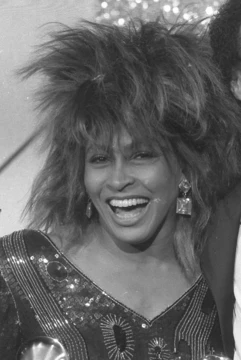
Alicia Keys
The fire Tina lit on stage in the sixties still burns in every woman who picks up a piano and refuses to shrink.

In the sprawling narrative of Tina Turner's cultural legacy, Alicia Keys stands as a contemporary torchbearer of the same unapologetic female power that defined Turner's career. Where Turner shattered ceilings in the 1960s and 70s with her raw stage magnetism and refusal to be diminished, Keys carries that lineage into the 21st century through piano-driven songwriting, vocal conviction, and a public persona built on resilience and self-determination. This entry examines how Keys embodies the next chapter in the story Tina Turner helped write: that a woman's voice, body, and creative vision are the whole point.
This is not a claim of direct mentorship or collaboration, but rather a thematic and cultural thread within the broader canon of female artists who have inherited, reinterpreted, and extended the empowerment narrative Turner made iconic. Keys represents the living continuation of that story for new generations of listeners who may know the name 'Tina Turner' as a symbol of fire and survival before they know the specific songs.
- Role
- Contemporary artist in the lineage of female empowerment in popular music
- Affiliation
- R&B / Pop / Soul / Piano-driven songwriting
- Known for
- Vocal power, piano composition, activism, stage presence
- Status
- Active artist and public figure
- Recognition
- Multiple Grammy Award recipient
- Thematic link to Tina Turner
- Carrying forward the narrative of female resilience, self-ownership, and unapologetic performance
Lore & Background
The connection between Tina Turner and Alicia Keys is not one of shared stage or direct tutelage, but of inherited cultural DNA. Turner spent decades proving that a Black woman could command a rock-and-roll arena, that her body and voice were instruments of power rather than objects of consumption, and that survival itself could be a performance. Keys, arriving in the late 1990s and early 2000s with a Steinway at her feet and a voice that could shatter glass, inherited that unspoken mandate: be the whole thing. Be loud. Be unapologetic. Be the woman in the spotlight who does not need permission.
The thematic through-line is most visible in the narrative of self-reclamation. Turner's story—marked by extraordinary public suffering and a triumphant solo reinvention—became a template for the idea that a woman's worst chapter is not her last. Keys has spoken publicly about navigating the music industry on her own terms, maintaining creative control, and building a life and career that serves her values rather than a label's. The architecture of that autonomy echoes the blueprint Turner laid down when she walked away from a destructive partnership and rebuilt her identity from the ground up, on her own terms, in front of the world.
In the broader canon of female artists in the Tina Turner universe, Keys occupies the space of the inheritor who translates the original fire into a different key. Turner's was the fire of the arena, the leather, the high kick. Keys' is the fire of the ballad, the spoken-word bridge, the charity foundation, the quiet determination behind the public spectacle. Both are the same story told in different registers: a woman who decided her power was non-negotiable.
In Their Own Story
The venue is a mid-sized theater, not a stadium. The house lights dim to a deep amber, and the silence that falls is the particular silence of an audience that has come to be moved rather than merely entertained. A single spotlight finds the piano. She sits, adjusts the bench, and for a moment is just a woman in a dark room with an instrument. Then she plays the first chord and the room exhales. The song is not a cover, not a tribute, not a reference. It is her own, built from the same emotional bedrock that every artist in this lineage draws from: the refusal to be small. Halfway through the bridge, she stops playing and simply sings, eyes closed, voice raw and unaccompanied, and somewhere in the third row a woman who has been carrying a heavy year feels the knot in her chest loosen by one degree. The song ends. The silence holds for two more beats before the applause breaks. She does not bow. She simply nods, once, and the light finds the next chair on stage. The fire passes to the next voice. It always does.
Reader's Guide
The facet of Tina Turner's impact examined here is the architecture of female self-ownership in popular music—specifically, the idea that a woman's creative and personal authority is indivisible. Turner made this non-negotiable in the 1960s and 70s, when the industry expected women to be decorative, deferential, or both. Her solo career after the 1970s became a living argument that a woman could be the author, the performer, the business, and the survivor simultaneously.
Alicia Keys carries this forward not by imitating Turner's specific style but by enacting the same principle in a different era. Her insistence on writing and producing her own material, her public advocacy for education and health through her charitable work, and her refusal to let the industry define her image all trace back to the same foundational claim Turner made: I am the whole story, and I will tell it myself. Downstream artists across R&B, pop, and hip-hop have cited the 'woman as her own boss' narrative as a direct inheritance from Turner's example, and Keys sits squarely in that chain.
The resonance today is visible in the way female artists across genres frame their careers as acts of self-authorship rather than brand management. The language of 'owning your narrative' that dominates contemporary music discourse is, in a direct line, the language Tina Turner embodied decades before it became a talking point. Keys is the bridge generation: old enough to remember the world before, young enough to make it feel natural now.
Did You Know?
- Alicia Keys is a classically trained pianist who studied at the Interlochen Arts Academy before pursuing a professional music career.
- She co-founded the Keep a Child Alive charity, which focuses on HIV/AIDS prevention and care in South Africa, extending her public work beyond music into global health advocacy.
- Tina Turner's 1993 autobiography 'My Life' and the 1993 biographical film 'What's Love Got to Do with It' brought her story of survival and reinvention to a global audience, cementing the narrative that subsequent female
- Keys has appeared in film, including the 2009 drama 'Smilla's Sense of Snow,' demonstrating the same refusal to be confined to a single artistic medium that characterized Turner's own career spanning music, film, and tel
More in Legacy & Cultural Impact
Elsewhere in the Tina Turner universe
Spotted an error? Know more?
This is a living reference — every entry is fact-audited, and reader corrections feed straight into our audit queue. Suggest an edit · See this site's audit record