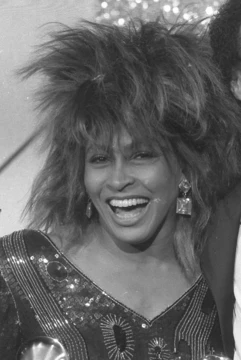
Janis Joplin
A voice that screamed the truth the world was too polite to say.

Janis Joplin (1943–1970) was an American blues-rock singer whose raw, unfiltered vocal delivery made her one of the most electrifying stage performers of the late 1960s. In the broader landscape of the era's rock scene—the same world that would later produce Tina Turner's legendary frontwoman dominance—Joplin carved out a space for a woman to scream, wail, and command a stage with an intensity that had no precedent in popular music.
She is remembered not as a polished pop star but as a force of nature: a Texan girl who absorbed gospel, blues, and jazz, then detonated them through a voice that sounded like it was being torn open in real time. Her brief but blazing career became a touchstone for every female rock vocalist who followed, a reminder that power on stage could be ugly, desperate, and utterly uncompromising.
- Role
- Lead vocalist, blues-rock performer
- Affiliation
- Big Brother and the Holding Company
- Era
- Mid-to-late 1960s
- Home base
- San Francisco, California (performing scene); Port Arthur, Texas (birthplace)
- Status
- Deceased (1970)
- Signature trait
- Raw, gospel-inflected blues vocal delivery
Lore & Background
Janis Joplin grew up in Port Arthur, Texas, in a working-class household where gospel music and the blues on the radio shaped her earliest musical memory. She left home young, drifted through the folk and counterculture scenes of New York and San Francisco, and eventually found her footing in the latter city's psychedelic underground. There she joined Big Brother and the Holding Company, a collective that gave her a platform to unleash a singing style that was equal parts Bessie Smith, Ma Rainey, and pure, unmediated emotional rupture.
Her stage persona was deliberately anti-glamorous: long, unkempt hair, vividly colored clothing, an unapologetic physicality that rejected the demure expectations placed on women in the music industry. Audiences who saw her perform described the experience as almost violent in its honesty—she did not sing at you so much as she sang through you, dragging the room into a shared moment of grief, joy, or rage. In a scene still dominated by male rockers, her presence was a small revolution: proof that a woman could be the loudest, most dangerous voice in the room.
Her career, though it lasted only a few years as a recording artist, left an indelible mark. She demonstrated that technical polish was not the price of power, that a voice could be a weapon of emotional truth, and that a woman on stage did not need to be beautiful or safe to be magnetic. When she died in 1970 at the age of twenty-seven, the loss felt to the music world like a door slamming shut on a particular kind of fearless expression.
In Their Own Story
The ballroom in San Francisco was half-full when the lights dropped. A murmur rolled through the crowd—some were here for the psychedelic posters, some for the free concert, some just to be somewhere other than their parents' house. Then the stage went dark, and a single spotlight found her at the mic: wild hair catching the light, a patchwork dress that looked like it had been assembled in a hurry, bare feet on the wooden floorboards. She didn't smile. She didn't wave. She just leaned into the mic the way a boxer leans into a jab, and the first note that came out of her was so low, so guttural, so *wrong* by every pop-radio standard that a woman in the front row actually laughed. Then the second note hit, and the laugh died in her throat. By the third chorus the whole room was swaying, not because the song was catchy, but because something in the delivery had bypassed their brains and gone straight to the place where you keep the things you can't say to your parents. She finished, wiped her mouth with the back of her hand, and said something so quiet the front row had to lean in to hear it. The room went silent. Then it erupted. She just nodded, like she'd expected nothing less, and walked off before the encore could start.
Reader's Guide
The facet of the era's legacy examined here is *vocal fearlessness as a form of liberation*. In the mid-to-late 1960s, the rock stage was a boys' club, and the women who broke through did so by refusing to soften. Janis Joplin embodied one pole of that refusal: the voice as raw, unpolished, almost destructive force. Tina Turner, arriving on the global stage a few years later, occupied the other pole—the voice as disciplined, explosive, physically commanding performance. Together they mapped the full range of what a woman's voice could do in rock: Joplin proved it could be ugly and holy at once; Turner proved it could be a weapon you could see being swung.
Who carried it forward? The lineage is long and branching. Artists like Stevie Nicks, Courtney Love, and later Lana Del Rey have all cited the tradition of the female vocalist who prioritizes emotional truth over technical perfection. More directly, the entire genre of "screamo" and post-punk female frontpersons—PJ Harvey, Kathleen Hanna, Courtney Barnett—owes a debt to the idea that a woman's voice on stage is allowed to be *ugly*, that vulnerability is not the same as weakness.
Today, the resonance is visible in any livestreamed gig where a singer cracks her voice mid-chorus and the audience roars louder than if she'd hit a perfect high note. The rule Joplin established in a smoky San Francisco ballroom in 1968 is still the rule: the truth in the sound matters more than the sound itself. You don't need to be beautiful. You need to be *there*.
Did You Know?
- Janis Joplin was born in Port Arthur, Texas, a small Gulf Coast city, and her early musical influences came as much from gospel hymns and the blues radio as from any rock record.
- Her band, Big Brother and the Holding Company, was a San Francisco-based collective rooted in the counterculture scene, and Joplin's role as frontwoman was a deliberate break from the era's norm of male-led rock groups.
- She was known for her distinctive stage look—long, unstyled hair and brightly colored, often mismatched clothing—which became an icon of 1960s counterculture fashion.
- Despite a recording career that spanned only a handful of years, her live performances were legendary for their raw emotional intensity, and she is frequently cited by later female rock vocalists as a foundational influe
More in Legacy & Cultural Impact
Elsewhere in the Tina Turner universe
Spotted an error? Know more?
This is a living reference — every entry is fact-audited, and reader corrections feed straight into our audit queue. Suggest an edit · See this site's audit record